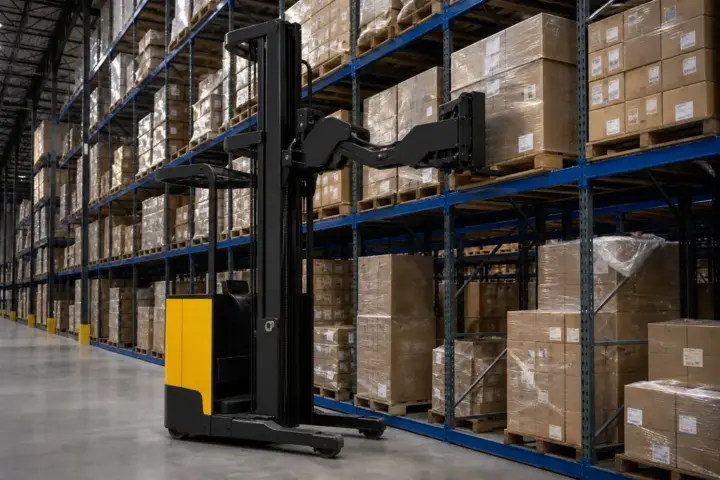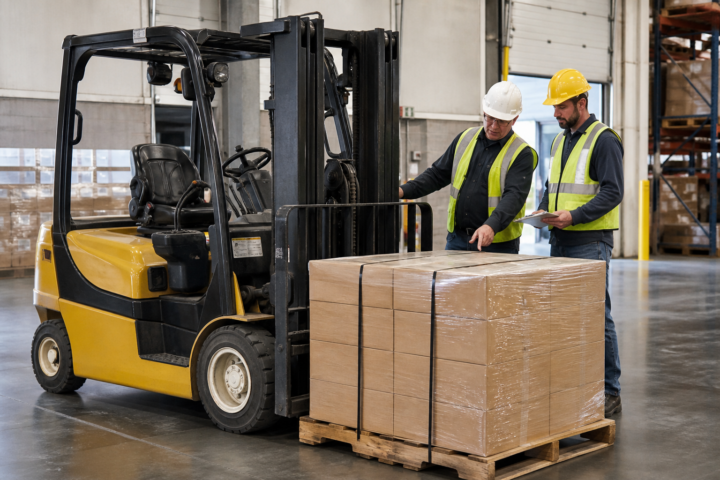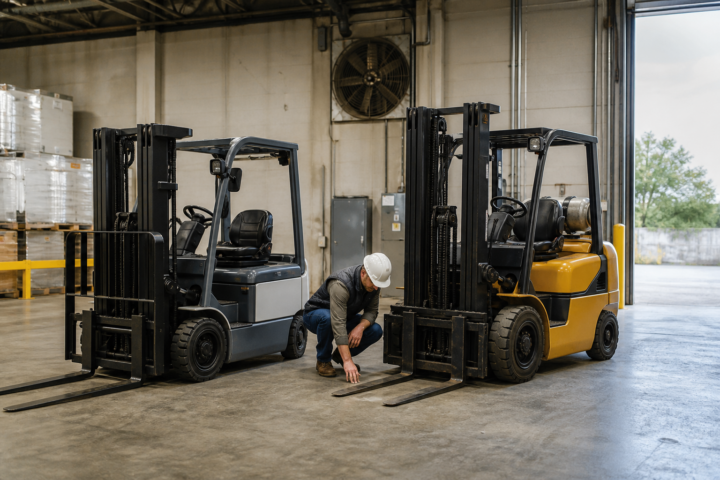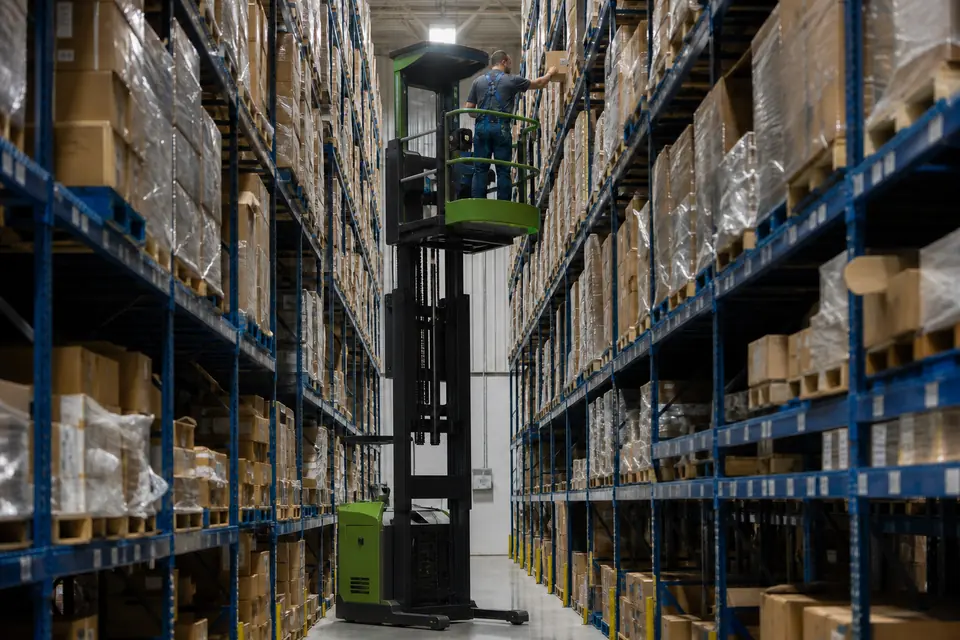
A forklift mast looks straightforward until a truck reaches the building and will not clear a doorway, lift the top pallet safely, or carry the stated capacity at the height you actually need. We see versions of that problem whenever a buyer shops by maximum lift height alone. The mast has to work through the whole route—from the trailer or receiving door to the highest rack position—not just at the final destination.
The useful way to choose a mast is to work from three measurements: the lowest overhead obstruction the truck must pass under, the highest fork position required, and the real load at that height. Then add the details that are easy to overlook: load center, attachment, tire type, floor condition and whether the truck must lift while the mast is still below an obstruction.
Start with the three heights that actually matter
Lowered mast height is the overall mast height when the forks and mast sections are fully lowered. This determines whether the truck can pass through a doorway, under a mezzanine, into a trailer or beneath overhead utilities. Measure the obstruction rather than relying on a nominal door size. A door labeled eight feet may have tracks, lights, guards or an uneven threshold that reduce usable clearance.
Maximum fork height is the highest position the forks can reach. That number should exceed the height needed to place the load, not merely the height of the top rack beam. The forks need to rise enough to clear the beam and allow the pallet to enter cleanly. At the same time, extra mast height can add cost, weight and complexity, so there is no benefit in buying dramatically more reach than the operation requires.
Free lift is the amount the forks can rise before the inner mast rails extend above the mast’s lowered height. This is important in trailers, containers, low-ceiling production areas and buildings with overhead obstructions. If a truck must pick or stack while staying below a ceiling, free lift may matter more than the mast’s headline maximum height.
Two-stage, three-stage and four-stage masts
A two-stage mast, sometimes called a duplex, uses two rail sections. It is mechanically simple and can provide good visibility. Two-stage masts are common where lift heights are moderate and overhead clearance is not especially tight. Some versions provide full free lift; others provide limited free lift, so the stage count by itself does not answer every clearance question.
A three-stage or triplex mast uses three rail sections. It is popular in warehouses because it can combine a relatively low collapsed height with enough reach for taller racking. That flexibility is useful, but buyers still need the actual specification sheet. Two triplex masts can have different lowered heights, free-lift amounts and maximum fork heights.
A four-stage or quad mast uses four nested rail sections to create substantial lift from a compact lowered package. That can solve a difficult height-to-doorway problem. It can also bring tradeoffs in visibility, mast weight, maintenance and residual capacity. We would not recommend a quad mast simply because it reaches higher. It makes sense when the facility measurements require it and the truck remains properly rated for the load.
Why stated truck capacity is not the final answer
The capacity printed in a forklift listing is normally tied to a specific load center and configuration. Raising a load higher, moving its center farther forward, installing a heavy attachment or changing the mast can reduce the capacity available in the real application. That reduced usable rating is often called residual capacity.
For example, a truck advertised as a 5,000-pound forklift should not automatically be treated as capable of placing every 5,000-pound load at its maximum height. A long load, an attachment that moves the load forward, or a tall mast may change the approved rating. Our forklift capacity guide explains why the load center and actual configuration need to be reviewed together.
This is also why we ask for more than load weight when preparing a quote. Load dimensions, pick orientation and height can be just as important. If the load varies, provide the heaviest and most difficult routine load—not the easiest pallet in the building.
Measure the route, not only the rack
Walk the exact route the forklift will travel. Record clear doorway height and width, overhead door hardware, rack tunnels, sprinkler or utility clearance, trailer openings, ramps and floor transitions. For warehouse work, measure the working aisle as well. A taller mast, a different truck chassis or an attachment can change the space the operator needs to turn and square a load.
It helps to photograph the tight locations and mark the measurements directly on a simple floor plan. Buyers often discover that the limiting point is not the rack—it is the receiving door, a low crossbeam or the trailer where pallets are unloaded. Use our forklift aisle-width guide alongside the mast measurements so the truck is evaluated as a complete package.
Visibility, hoses and attachments deserve attention
Mast rails, cylinders and hose routing affect the operator’s view through the mast. That does not make one mast style universally better, but it does mean the operator should evaluate visibility with the intended forks and attachment. If the truck will handle unusual loads, visibility around the load may be more important than the empty-truck view.
Attachments also change the conversation. A sideshifter, fork positioner, clamp or rotator can require additional hydraulic functions and hose groups. It adds weight at the carriage and may move the load center forward. Ask the dealer to quote the mast, carriage, hydraulics, attachment and capacity plate as one approved configuration. Pricing an attachment separately and assuming it will fit later is where avoidable surprises start.
How mast selection affects forklift prices
Mast height and stage count can affect acquisition cost, availability, freight and resale appeal. A common three-stage configuration may be easier to source than a specialized very-high-lift mast. A quad mast or unusual carriage can narrow the inventory pool. On used equipment, mast condition can also become a meaningful part of the value calculation.
Do not compare forklift prices until the quotes use comparable mast specifications. One truck may look cheaper because it has less free lift, a lower maximum height or a capacity rating that does not hold at your top rack. The right comparison is delivered price for a truck that clears the building and handles the required load at height.
What to inspect on a used forklift mast
Look for obvious rail damage, weld repairs, uneven carriage movement, chain condition, leaking cylinders, damaged rollers and worn fork locking components. Raise and lower the mast through its operating range without a load, then have a qualified person evaluate it under appropriate conditions. Listen for binding or abrupt movement and confirm that the carriage remains controlled.
Also compare the truck’s data plate with the installed mast and attachment. A clean-looking truck is not enough if the capacity information no longer reflects its configuration. Our used forklift inspection checklist covers the rest of the machine so the mast is not judged in isolation.
Information to include when requesting a mast-equipped forklift quote
- Heaviest routine load and its dimensions
- Required maximum fork height
- Lowest overhead clearance on the travel route
- Whether lifting is required inside trailers or low-ceiling areas
- Aisle width, rack layout and floor conditions
- Required attachment and hydraulic functions
- Indoor, outdoor or mixed use
- Expected daily operating hours and shift pattern
- Delivery ZIP code and target date
With those details, a dealer can compare suitable two-stage, three-stage and four-stage options instead of sending a list of trucks that happen to have tall masts.
Frequently asked questions
Is a three-stage mast always better than a two-stage mast?
No. A three-stage mast often provides more lift from a lower collapsed height, but a two-stage mast may be simpler and entirely appropriate when the required height and clearance allow it.
How much extra lift height should I buy?
Enough to clear the top placement safely, with a reasonable operating allowance. Excessive unused height can add cost and may affect weight, visibility or residual capacity.
Does a forklift attachment reduce lifting capacity?
It often can. Attachment weight and thickness may move the effective load center forward, so the complete configuration needs an approved capacity rating.
Can I determine free lift from the mast stage count?
Not reliably. Confirm the manufacturer’s specification for the exact mast because free lift varies by design and configuration.
If you have the measurements but are not sure which mast configuration fits, review available forklift equipment and get forklift quotes based on the full application—not lift height alone.